This page describes the interpolant of NcmSplineHermite: the quintic through the values and the first two derivatives at the knots, as NcmOdeSpline, NcDistance and NcGrowthFunc use it, and the measurements behind the ODE order they pair it with.
The interpolant
Let the knots be \(x_0 < x_1 < \dots < x_{n-1}\) with the values \(y_i\), the first derivatives \(y'_i\) and the second derivatives \(y''_i\) given at each of them, \(h_i \equiv x_{i+1} - x_i\) and \(\Delta x \equiv x - x_i\). On \([x_i, x_{i+1}]\) the interpolant is the quintic \[
s(x) = y_i + y'_i\,\Delta x + \tfrac{1}{2} y''_i\,\Delta x^2 + c_{3,i}\,\Delta x^3 +
c_{4,i}\,\Delta x^4 + c_{5,i}\,\Delta x^5,
\] whose three free coefficients are fixed by \(s(x_{i+1}) = y_{i+1}\), \(s'(x_{i+1}) =
y'_{i+1}\) and \(s''(x_{i+1}) = y''_{i+1}\). With \[
A_i \equiv \frac{y_{i+1} - y_i - h_i y'_i - \tfrac{1}{2} h_i^2 y''_i}{h_i^3}, \qquad
B_i \equiv \frac{y'_{i+1} - y'_i - h_i y''_i}{h_i^2}, \qquad
C_i \equiv \frac{y''_{i+1} - y''_i}{h_i},
\] they are \[
c_{3,i} = 10 A_i - 4 B_i + \tfrac{1}{2} C_i, \qquad
c_{4,i} = \frac{-15 A_i + 7 B_i - C_i}{h_i}, \qquad
c_{5,i} = \frac{6 A_i - 3 B_i + \tfrac{1}{2} C_i}{h_i^2}.
\]ncm_spline_prepare() computes \(c_{3,i}\), \(c_{4,i}\) and \(c_{5,i}\) for every interval and nothing else: the interpolant is local, no linear system is solved, and preparation costs \(O(n)\). Evaluation, the derivatives and the integral follow from the polynomial on the interval found by the knot search of NcmSpline. The derivative vectors are data, not derived quantities, so they are properties of the object and serialize with the knots and values.
Smoothness
\(s\), \(s'\) and \(s''\) are continuous at every knot by construction, so \(s \in C^2\), and the third derivative jumps. The size of the jump is what a method applied downstream sees. A cubic spline through the same knots is also \(C^2\), with a third derivative constant on each interval, and its jump at a knot is of order \(h\,f^{(4)}\); the quintic’s is of order \(h^3 f^{(6)}\). The two scalings are measured below on \(\sin x\) with uniform knots, the third derivative at each side of a knot taken from \(s''\) by a one-sided difference.
knots
cubic not-a-knot
quintic Hermite
11
6.96e-01
3.71e-03
21
3.14e-01
4.80e-04
41
1.57e-01
4.87e-05
Halving \(h\) divides the cubic’s jump by about 2 and the quintic’s by about 8.
A smooth function of the spline keeps this. For \(g \in C^\infty\), \[
(g \circ s)''' = g'''(s)\,s'^3 + 3 g''(s)\,s'\,s'' + g'(s)\,s''',
\] and only \(s'''\) jumps, so \(g \circ s\) is \(C^2\) with a third-derivative jump of \(g'(s)\,[s''']\): the same class and the same scaling, multiplied by \(g'\).
Error
For \(f \in C^6\) the interpolation error on \([x_i, x_{i+1}]\) is \[
f(x) - s(x) = \frac{f^{(6)}(\xi)}{6!}\,(x - x_i)^3 (x - x_{i+1})^3, \qquad
\xi \in [x_i, x_{i+1}],
\] largest at the midpoint, where \(|(x - x_i)^3 (x - x_{i+1})^3| = h_i^6 / 64\), so \[
|f(x) - s(x)| \le \frac{h_i^6}{46080} \max |f^{(6)}|.
\]
knots
bound
measured on \(\sin x\)
11
1.34e-06
1.33e-06
21
2.09e-08
2.06e-08
41
3.26e-10
3.25e-10
Knots from an ODE solver
NcmOdeSpline takes its knots from the steps of CVODE’s Adams method. At a step \(y\) is the solver’s state, \(y' = f(y, x)\) is the right-hand side, and \(y''\) comes from the d2ydx2 callback when the caller has it in closed form, as NcDistance does with \(\mathrm{d}^2 D_c/\mathrm{d}z^2 = -(\mathrm{d}E^2/\mathrm{d}z) / (2 E^3)\), and otherwise from CVODE’s interpolating polynomial through CVodeGetDky(), which is not available at the first steps, where the order is one; those knots take the difference quotient of \(y'\) to the next knot. NcGrowthFunc integrates \((D, \mathrm{d}D/\mathrm{d}a)\), so \(y'\) is in the state and \(y''\) is the right-hand side.
The step size the solver chooses matches its own order, and the quintic needs the spacing of an order 5 to 7 method: above that the interpolation error between the knots exceeds the integration error at the knots. Measured on the comoving distance of NcHICosmoDECpl with its default parameters on \(z \in [0, 10^{10}]\) at relative tolerance \(2.2 \times 10^{-16}\), the largest relative error at the knots and at the interval midpoints below \(z = 10\):
Adams max order
knots
at the knots
at the midpoints
3 (cubic spline)
78823
1.8e-12
4.6e-13
5
7451
9.1e-14
1.5e-14
7
2796
8.1e-15
9.0e-15
8
2132
5.6e-15
5.6e-14
12
1306
6.0e-15
1.4e-13
Order 7 is the default of NcmOdeSpline:max-order with a NcmSplineHermite.
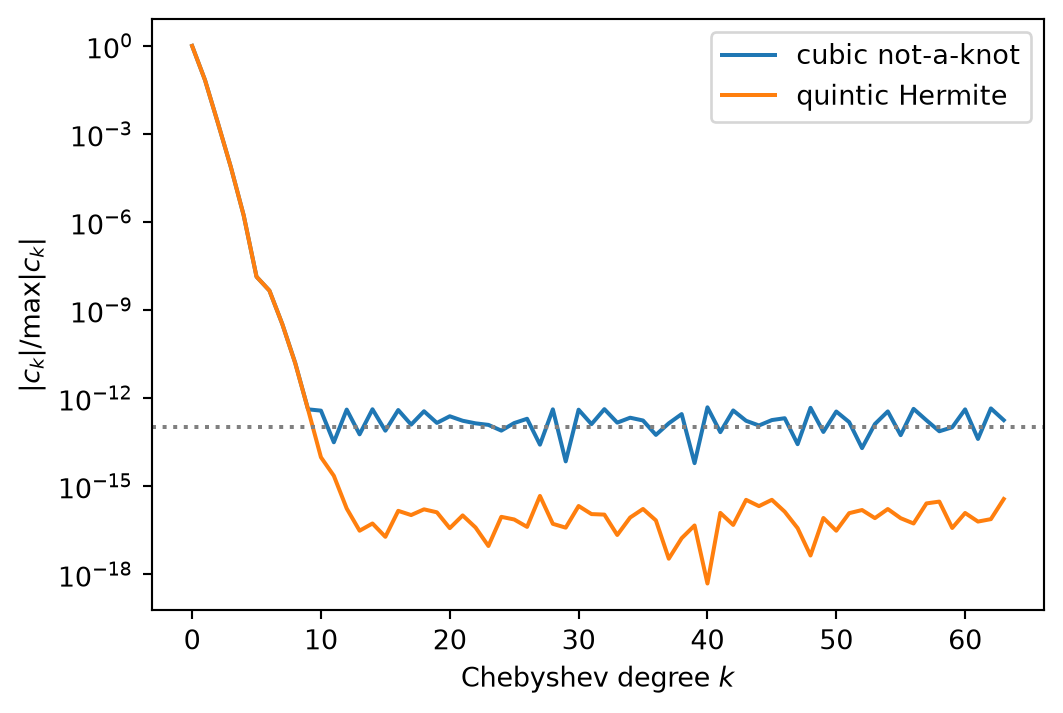
The figure shows what the smoothness buys downstream, on the comoving distance spline of NcDistance: the Chebyshev coefficients of the quintic on one panel of \(z\), against those of a cubic not-a-knot spline through the same knots. The cubic’s coefficients stop falling at the size of its third-derivative jumps; the quintic’s fall to roundoff.
Code
cosmo = Nc.HICosmoDECpl()dist = Nc.Distance.new(1.0e10)dist.prepare(cosmo)quintic = dist.comoving_distance_spline.peek_spline()cubic = Ncm.SplineCubicNotaknot.new()cubic.set(quintic.peek_xv(), quintic.peek_yv(), True)a, b =1.0, 1.5N =128j = np.arange(N +1)z =0.5* (a + b) +0.5* (b - a) * np.cos(math.pi * j / N)weights = np.where((j ==0) | (j == N), 0.5, 1.0)k = np.arange(N +1)cos_jk = np.cos(math.pi * np.outer(j, k) / N)fig, ax = plt.subplots(figsize=(6, 4))for s, name in ((cubic, "cubic not-a-knot"), (quintic, "quintic Hermite")): f = np.array([s.eval(v) for v in z]) c =2.0/ N * (weights * f) @ cos_jk c = np.abs(c) / np.abs(c).max() ax.semilogy(k[:64], c[:64], label=name)ax.axhline(1.0e-13, color="gray", linestyle=":")ax.set_xlabel("Chebyshev degree $k$")ax.set_ylabel("$|c_k| / \\max |c_k|$")ax.legend()plt.show()
Figure 1: Chebyshev coefficients, relative to the largest, of the comoving distance on \(z \in [1, 1.5]\) for the quintic Hermite spline of NcDistance and for a cubic not-a-knot spline through the same knots. A method resolving the panel to \(10^{-13}\) needs the degree where the curve crosses that level.